Preparing for a HIPAA audit can feel overwhelming for small healthcare practices, especially if compliance activities have been managed informally over time.
Fortunately, successful audit preparation is not about scrambling to gather documents after receiving an audit notice. It is about maintaining organized compliance activities, documentation, and evidence throughout the year.
Whether responding to an OCR investigation, a payer request, a business partner review, or conducting an internal compliance assessment, organizations that prepare continuously are better positioned to demonstrate their compliance efforts.
This guide outlines practical steps small healthcare practices can take to prepare for a HIPAA audit before one ever occurs.
What Is a HIPAA Audit?
A HIPAA audit is a review of an organization's compliance with applicable HIPAA Privacy, Security, and Breach Notification Rule requirements.
Audits may occur for several reasons, including:
- Office for Civil Rights (OCR) audit programs
- breach investigations
- patient complaints
- security incidents
- payer or contractual compliance reviews
- internal compliance assessments
Regardless of why an audit occurs, organizations should be prepared to demonstrate both their written policies and their operational compliance activities.
Why Preparation Matters
Many healthcare organizations believe they are compliant until they are asked to produce documentation.
Common problems include:
- outdated policies
- incomplete training records
- undocumented risk analyses
- missing Business Associate Agreements (BAAs)
- inconsistent review activities
- scattered documentation across multiple locations
The inability to quickly produce documentation often creates additional compliance concerns during an audit. Preparing before an audit helps reduce stress while demonstrating that compliance is an ongoing operational process.
Step 1. Perform a Security Risk Analysis
Every audit preparation process should begin with a current HIPAA Security Risk Analysis.
Verify that your organization maintains:
- a documented risk analysis
- identified threats and vulnerabilities
- remediation plans
- evidence of periodic reviews
- documentation showing completed corrective actions
Questions to ask:
- Has a risk analysis been completed?
- Is it reviewed regularly?
- Are identified risks tracked through remediation?
Review the guide to HIPAA risk analysis requirements for more detail on how this requirement works for small practices.
Step 2. Review Policies and Procedures
Auditors commonly request written policies and procedures.
Confirm that your organization has current documentation covering topics such as:
- Privacy Rule requirements
- Security Rule safeguards
- workforce responsibilities
- incident response
- password policies
- workstation security
- access controls
- data retention
- breach notification
Also verify that:
- policies have recent review dates
- revisions are documented
- staff know where policies are maintained
Review what HIPAA policies and procedures small practices need to keep this documentation aligned with real workflows.
Step 3. Verify Workforce Training
Training records are frequently requested during compliance reviews. Organizations should maintain evidence showing that workforce members receive appropriate HIPAA education.
Review:
- employee training records
- new hire training
- annual refresher training
- acknowledgment forms
- role-specific security training
Questions to ask:
- Can training records be produced quickly?
- Are all employees current?
- Is training documented consistently?
Review what HIPAA employee training requirements mean for small practices.
Step 4. Complete an Internal Audit
Internal audits help identify compliance gaps before external reviewers discover them.
A practical internal audit should evaluate:
- administrative safeguards
- technical safeguards
- physical safeguards
- workforce compliance
- documentation
- vendor management
- incident response
- recurring compliance activities
Document all findings along with remediation plans and follow-up activities. A practical HIPAA internal audit checklist can help make that review more consistent.
Step 5. Organize Audit Evidence
One of the biggest challenges during an audit is locating documentation.
Maintain organized evidence such as:
- completed risk analyses
- policy review records
- training documentation
- Business Associate Agreements
- incident reports
- audit log reviews
- meeting minutes
- remediation documentation
- compliance review records
Evidence should be organized so it can be produced quickly if requested. Review the HIPAA audit evidence checklist for a more detailed evidence framework.
Step 6. Review Audit Logs
Organizations should verify that systems generating audit logs are functioning properly and that review activities are documented.
Review logs related to:
- user authentication
- patient record access
- failed login attempts
- administrative changes
- security alerts
- unusual system activity
Questions to ask:
- Are logs reviewed regularly?
- Are unusual events investigated?
- Are reviews documented?
Review HIPAA audit log requirements for practical logging and monitoring expectations.
Step 7. Review Business Associate Agreements
Organizations should maintain current documentation for vendors that create, receive, maintain, or transmit protected health information.
Verify:
- signed BAAs
- current vendor inventories
- contract renewal dates
- vendor review documentation
Missing or outdated BAAs are among the more common compliance findings, and vendor documentation should be part of the practice's regular HIPAA compliance checklist activity.
Step 8. Verify Incident Documentation
Auditors may request evidence showing how security incidents are managed.
Maintain documentation including:
- incident reports
- investigation notes
- corrective actions
- mitigation efforts
- notification decisions
- resolution summaries
Organizations should be able to demonstrate that incidents are consistently documented and appropriately managed. Poor incident records are one of the operational gaps that can contribute to common HIPAA violations.
Step 9. Confirm Documentation Retention
HIPAA generally requires organizations to retain required documentation for at least six years from:
- the date the documentation was created
- or the date it was last in effect, whichever is later
Verify that documentation is:
- organized
- accessible
- securely stored
- retained according to organizational policy
Retention requirements may also be affected by state law, contractual obligations, employment regulations, or litigation holds.
Common HIPAA Audit Preparation Mistakes
Many small practices encounter avoidable issues such as:
- waiting until an audit notice arrives
- missing documentation
- outdated policies
- incomplete workforce training
- undocumented remediation efforts
- inconsistent audit log reviews
- expired Business Associate Agreements
- scattered compliance records
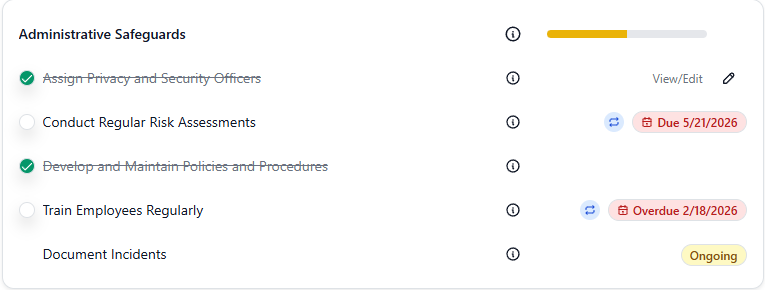
Preparation should be viewed as an ongoing compliance activity rather than a one-time project. Many HIPAA compliance issues are caused by missed deadlines, incomplete documentation, and lack of tracking. HIPAA Assistant's compliance tracking features help small practices stay organized before those gaps become problems.
Create an Annual Audit Readiness Routine
The easiest audits are the ones you prepare for continuously.
Consider establishing recurring reviews for:
- risk analysis updates
- policy reviews
- employee training
- audit log reviews
- vendor documentation
- incident response documentation
- internal audits
- compliance checklists
Regular review schedules reduce last-minute work and improve overall compliance maturity.
Turning Audit Preparation Into an Ongoing Process
Audit readiness is not achieved by completing a single checklist.
It comes from maintaining repeatable operational processes that keep compliance activities visible throughout the year.
A centralized compliance management process can help organizations:
- assign responsibilities
- track recurring compliance tasks
- maintain documentation
- organize audit evidence
- monitor remediation activities
- prepare for audits with confidence
HIPAA Assistant helps small healthcare practices organize compliance workflows, manage documentation, track recurring review activities, and maintain audit-ready records in one place.
Related resources
- HIPAA Internal Audit Checklist for Small Practices
- HIPAA Audit Evidence Checklist for Small Practices
- HIPAA Audit Log Requirements for Small Practices
- HIPAA Compliance Checklist for Small Practices
- HIPAA Risk Analysis for Small Practices
- HIPAA Policies and Procedures: What Small Practices Need
- HIPAA Employee Training Requirements for Small Practices