Healthcare organizations subject to the HIPAA Security Rule must implement administrative safeguards to protect electronic protected health information (ePHI). These safeguards establish the policies, procedures, workforce responsibilities, and ongoing management activities that help organizations reduce security risks and demonstrate compliance.
For small healthcare practices, administrative safeguards can feel overwhelming because they encompass many different operational responsibilities. In reality, they are best understood as the day-to-day management processes that keep HIPAA compliance active rather than a one-time project.
This guide explains what HIPAA administrative safeguards are, what they require, and how small healthcare practices can implement them effectively.
What Are HIPAA Administrative Safeguards?
Administrative safeguards are one of the three categories of safeguards established by the HIPAA Security Rule.
Together with Physical Safeguards and Technical Safeguards, they create the framework for protecting electronic protected health information (ePHI).
Administrative safeguards primarily focus on people, policies, and operational processes rather than technology.
Examples include:
- conducting risk analyses
- assigning security responsibilities
- developing policies and procedures
- training employees
- managing vendor relationships
- documenting incidents
- reviewing compliance activities
Many OCR enforcement actions involve administrative safeguard failures because organizations either never implemented required processes or could not demonstrate that those processes were consistently followed.
Why Administrative Safeguards Matter
Technology alone does not make an organization HIPAA compliant.
Even practices with secure networks and encrypted systems remain vulnerable if they:
- fail to assess risks
- neglect employee training
- do not review vendors
- lack written policies
- ignore ongoing compliance responsibilities
Administrative safeguards help organizations create repeatable compliance processes instead of relying on memory or informal practices. They also help practices reduce the types of operational gaps that can become common HIPAA violations.
Key Administrative Safeguards Every Practice Should Address
Perform a Security Risk Analysis
Every covered entity should periodically evaluate risks to ePHI.
Risk analyses typically include:
- identifying systems containing ePHI
- evaluating threats and vulnerabilities
- documenting findings
- prioritizing remediation
- reviewing changes over time
A documented risk analysis forms the foundation of every HIPAA compliance program. Learn more in the guide to HIPAA risk analysis for small practices.
Assign Security Responsibilities
HIPAA requires organizations to identify individuals responsible for privacy and security oversight.
Responsibilities often include:
- monitoring compliance activities
- approving policies
- coordinating workforce training
- reviewing incidents
- overseeing remediation efforts
Even very small practices benefit from clearly assigning these responsibilities rather than assuming they will happen automatically.
Develop Policies and Procedures
Policies translate HIPAA requirements into everyday office operations.
Examples include:
- access control policies
- workstation security
- incident response procedures
- password policies
- data retention procedures
- mobile device policies
Policies should be reviewed and updated regularly as technology and workflows change. Review what HIPAA policies and procedures small practices need to keep documentation aligned with real operations.
Train Workforce Members
Employees should receive HIPAA training appropriate to their responsibilities.
Training should cover:
- protecting patient information
- recognizing phishing attempts
- password security
- reporting incidents
- office privacy procedures
Practices should also document completion of training activities. The HIPAA employee training requirements guide explains how small practices can approach this as an ongoing workforce process.
Manage Business Associates
Organizations remain responsible for evaluating vendors that create, receive, maintain, or transmit protected health information.
Administrative safeguards include:
- maintaining Business Associate Agreements (BAAs)
- reviewing vendor relationships
- documenting vendor risk
- tracking agreement renewals
Vendor documentation should be organized with the rest of the practice's HIPAA audit evidence so it can be produced quickly during compliance reviews.
Document Security Incidents
Every organization should maintain procedures for documenting security incidents.
Documentation may include:
- incident reports
- investigation notes
- corrective actions
- notification timelines
- lessons learned
Keeping these records demonstrates that the practice actively manages security issues rather than simply reacting to them.
Review Compliance Regularly
HIPAA compliance is an ongoing operational process.
Recurring activities often include:
- annual risk analyses
- policy reviews
- employee refresher training
- audit preparation
- checklist reviews
- documentation updates
Regular reviews help ensure safeguards remain effective as the practice evolves. A practical HIPAA internal audit checklist can help make those reviews more consistent.
Common Administrative Safeguard Mistakes
Small healthcare practices often struggle with:
- outdated policies
- undocumented training
- incomplete risk analyses
- expired BAAs
- inconsistent incident documentation
- unclear responsibility assignments
- failure to review safeguards over time
Many of these issues are operational rather than technical, making them easier to correct through better organization and documentation. Practices preparing for outside review can use the HIPAA audit preparation guide to connect these activities to a broader audit-readiness routine.
Many HIPAA compliance issues are caused by missed deadlines, incomplete documentation, and lack of tracking. HIPAA Assistant's compliance tracking features help small practices stay organized before those gaps become problems.
Administrative Safeguards Work Best as a System
Administrative safeguards are interconnected.
For example:
- risk analyses identify issues
- policies define how those issues are managed
- training ensures employees follow procedures
- incident documentation records what happens
- internal audits verify the process is working
- ongoing reviews keep everything current
When these activities are managed together, HIPAA compliance becomes much more consistent and easier to demonstrate during an audit or investigation.
How HIPAA Assistant Helps
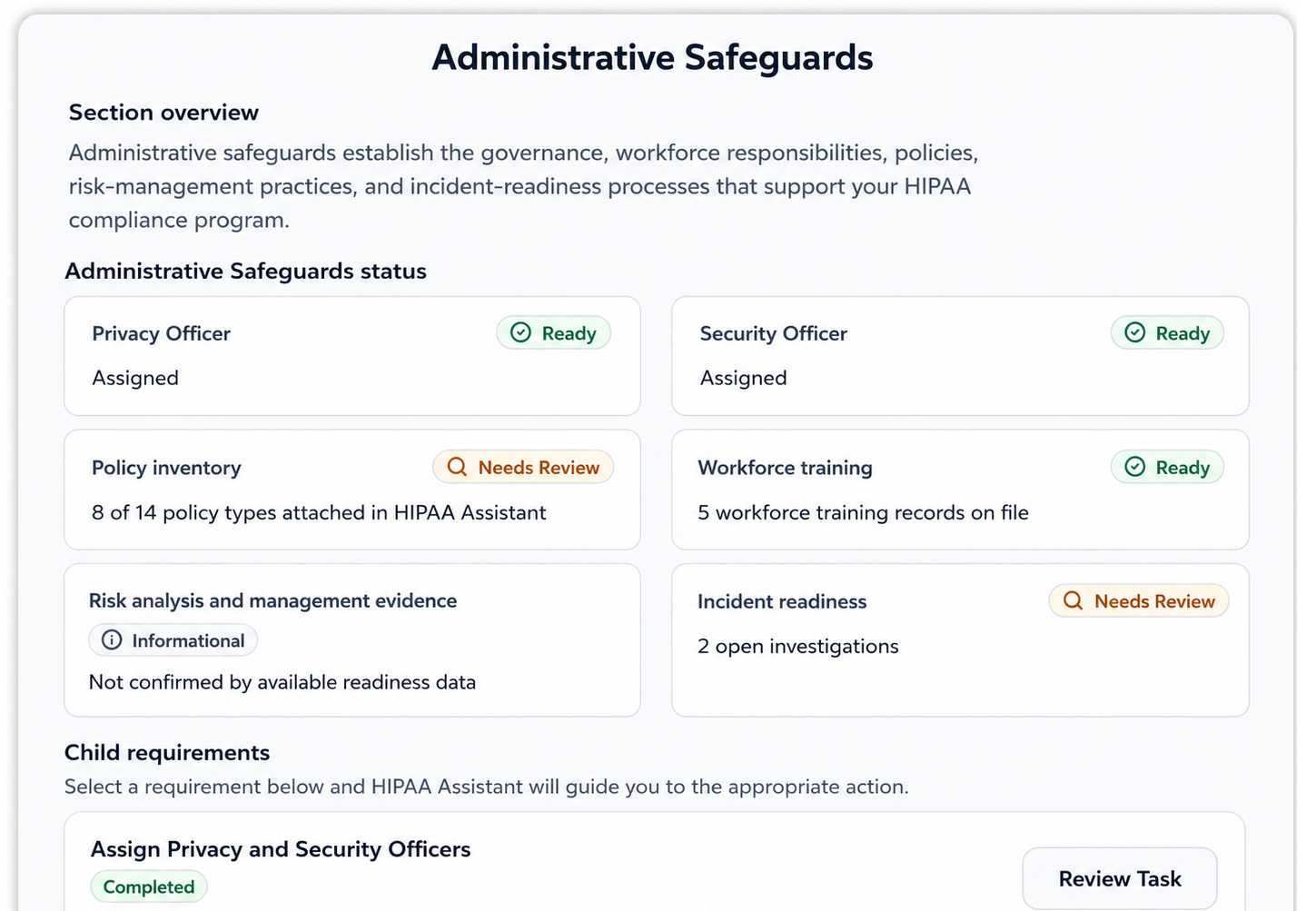
HIPAA Assistant helps small healthcare practices manage administrative safeguards by organizing recurring compliance activities in one place.
Practices can:
- track recurring compliance tasks
- assign responsibilities
- organize documentation
- monitor audit readiness
- maintain policy reviews
- prepare for internal and external audits
Instead of relying on spreadsheets and calendar reminders, practices can maintain a structured operational workflow that supports ongoing HIPAA compliance.
Final Thoughts
Administrative safeguards form the operational foundation of every HIPAA compliance program. While the individual requirements may seem extensive, they all support the same goal: creating repeatable processes that protect patient information and demonstrate compliance over time.
By performing regular risk analyses, maintaining current policies, training employees, documenting incidents, reviewing vendors, and monitoring ongoing compliance activities, small healthcare practices can build a much stronger HIPAA program.